
Gallery
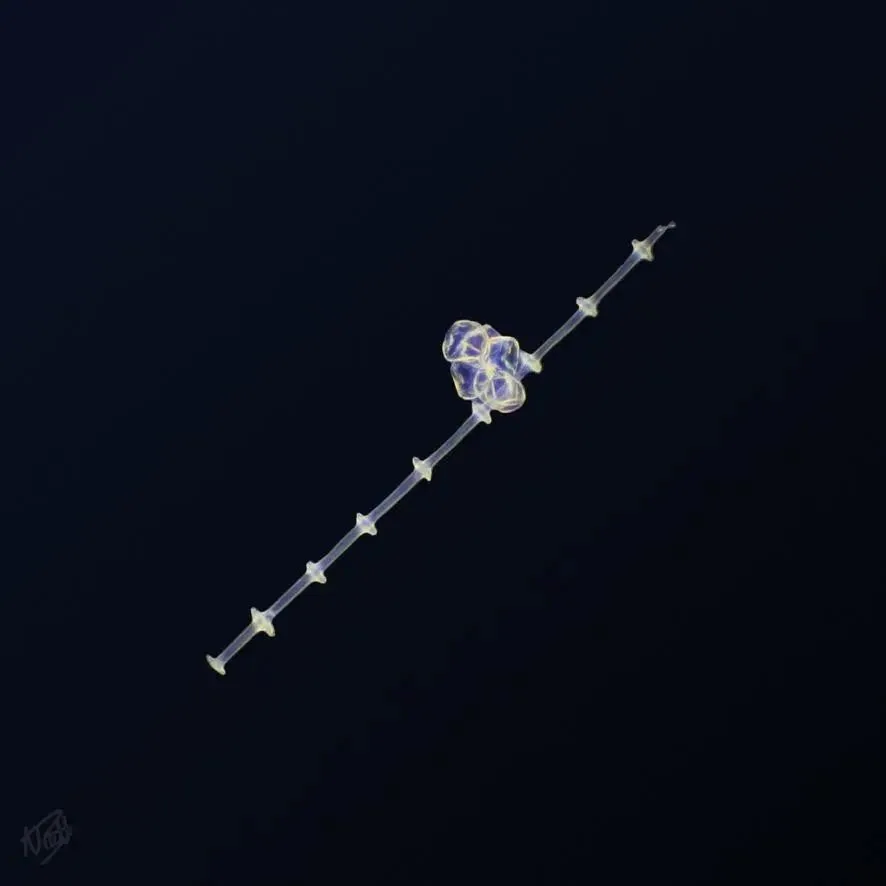
Stalked Colonial Ciliate
A colonial peritrich ciliate, likely Epistylis, extends its characteristic non-contractile stalk under darkfield illumination, with a cluster of individual zooids at the tip. Each zooid bears a crown of cilia for filter-feeding. These freshwater organisms frequently colonise submerged vegetation and the surfaces of aquatic invertebrates.
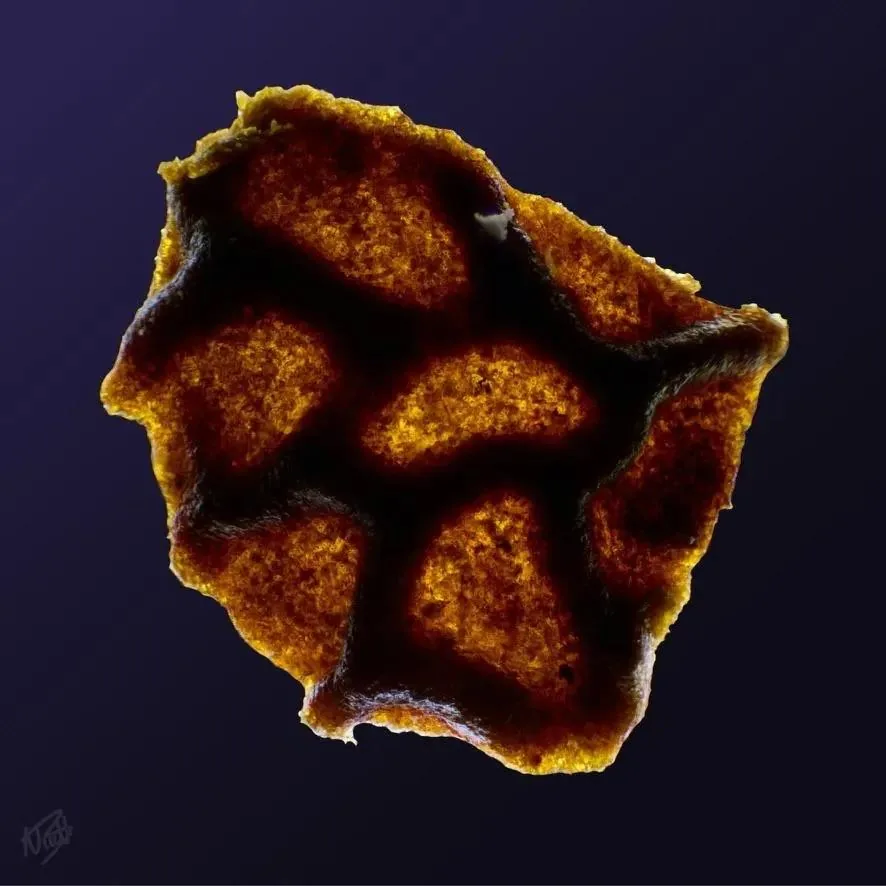
Plant Spore
A single plant spore, possibly from a moss or liverwort, photographed under compound microscope lighting. The amber outer wall (sporoderm) and irregular dark interior reveal the layered structure protecting the genetic material within. Plant spores are dispersed by air currents and can remain dormant for extended periods.
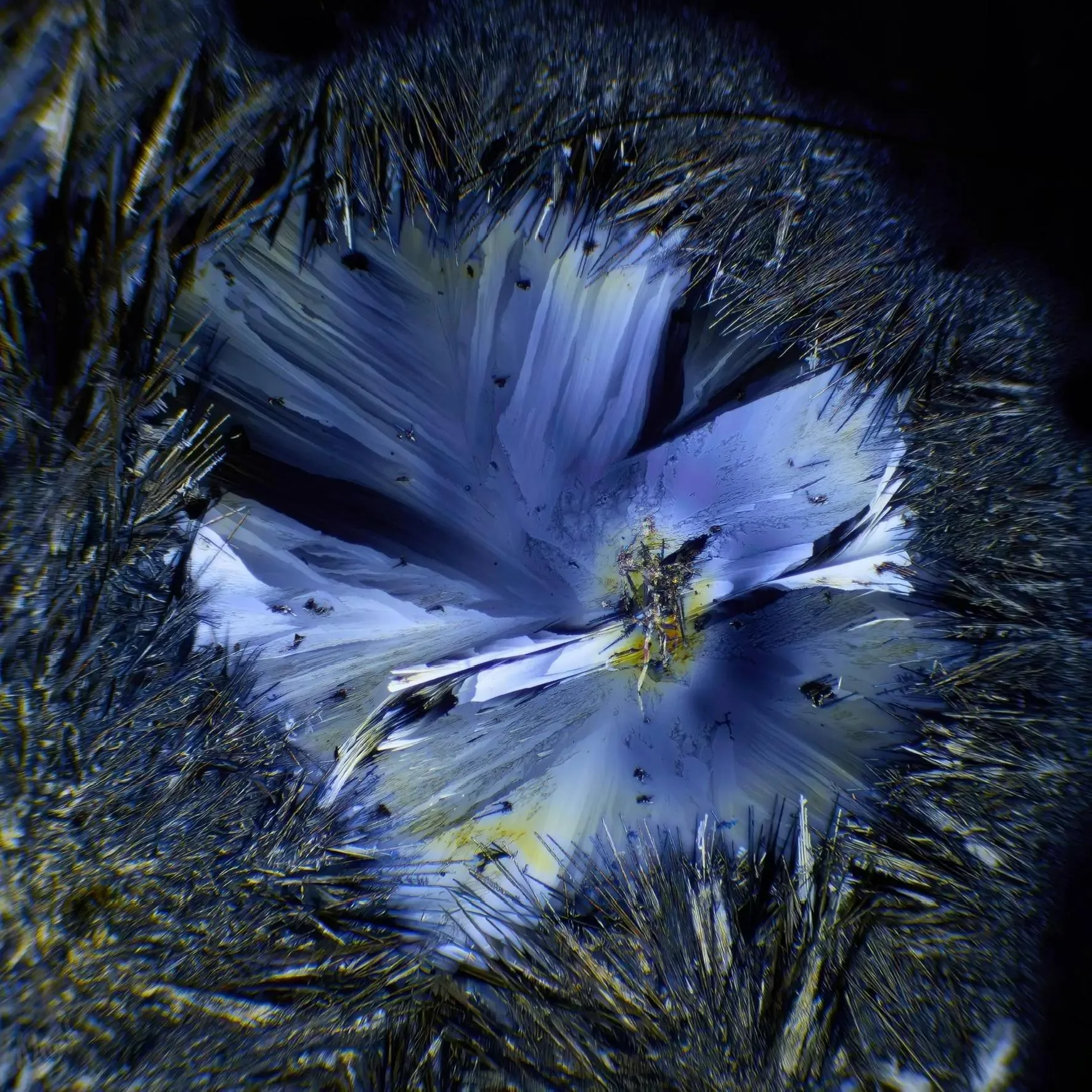
Crystallisation Under Polarised Light
Needle-like crystals of a birefringent compound burst outward from a central nucleation point, photographed under polarised light. When polarised light passes through a crystal, different orientations produce characteristic interference colours; the blue and white tones here indicate specific crystal thicknesses and optical axis orientations.
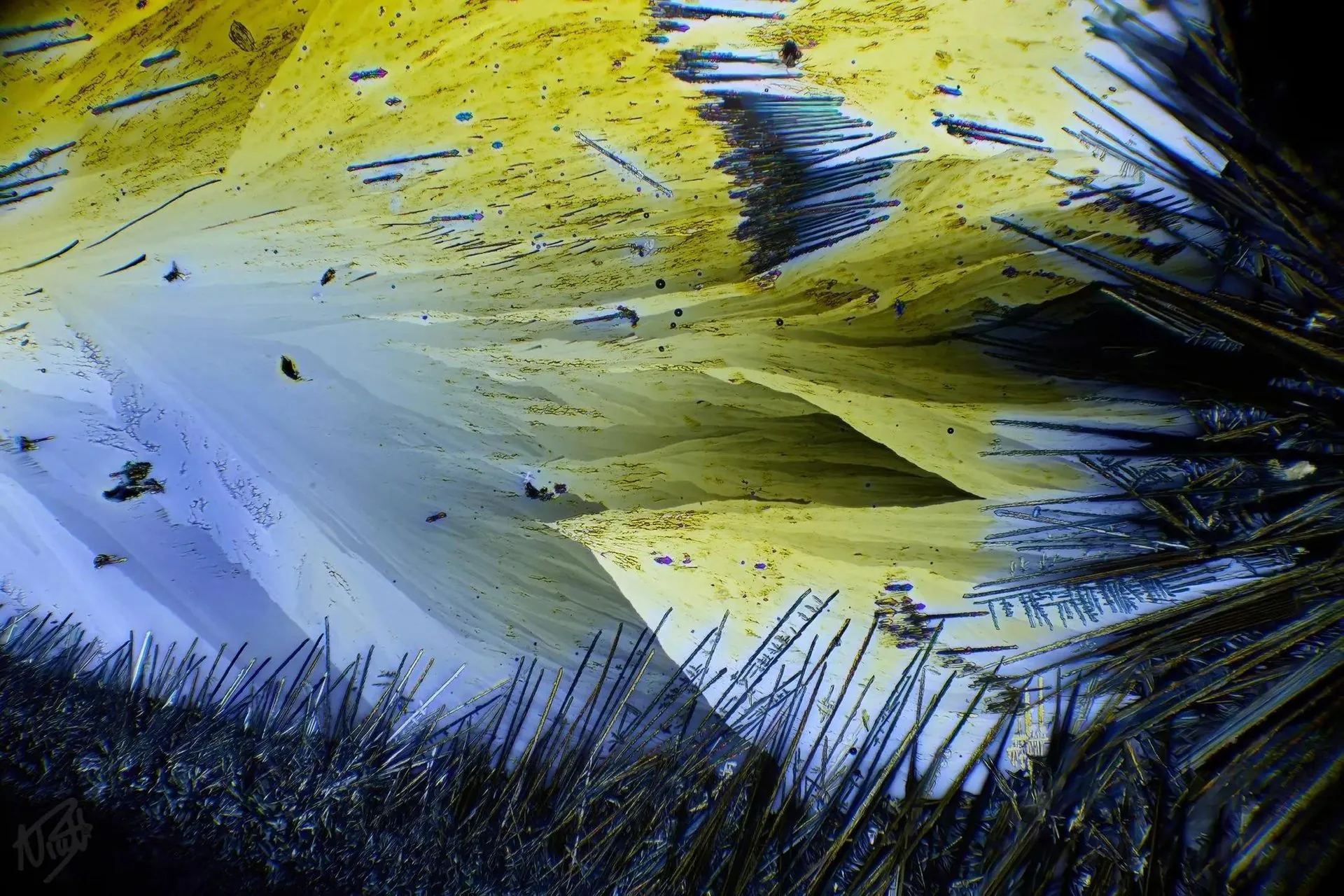
Crystal Landscape
Sweeping planes of a birefringent crystal fill the frame under cross-polarised light. The yellow and blue regions represent areas where the crystal’s optical axis is oriented at different angles to the polarisers, revealing the internal structure of what appears to the naked eye as a single uniform solid.
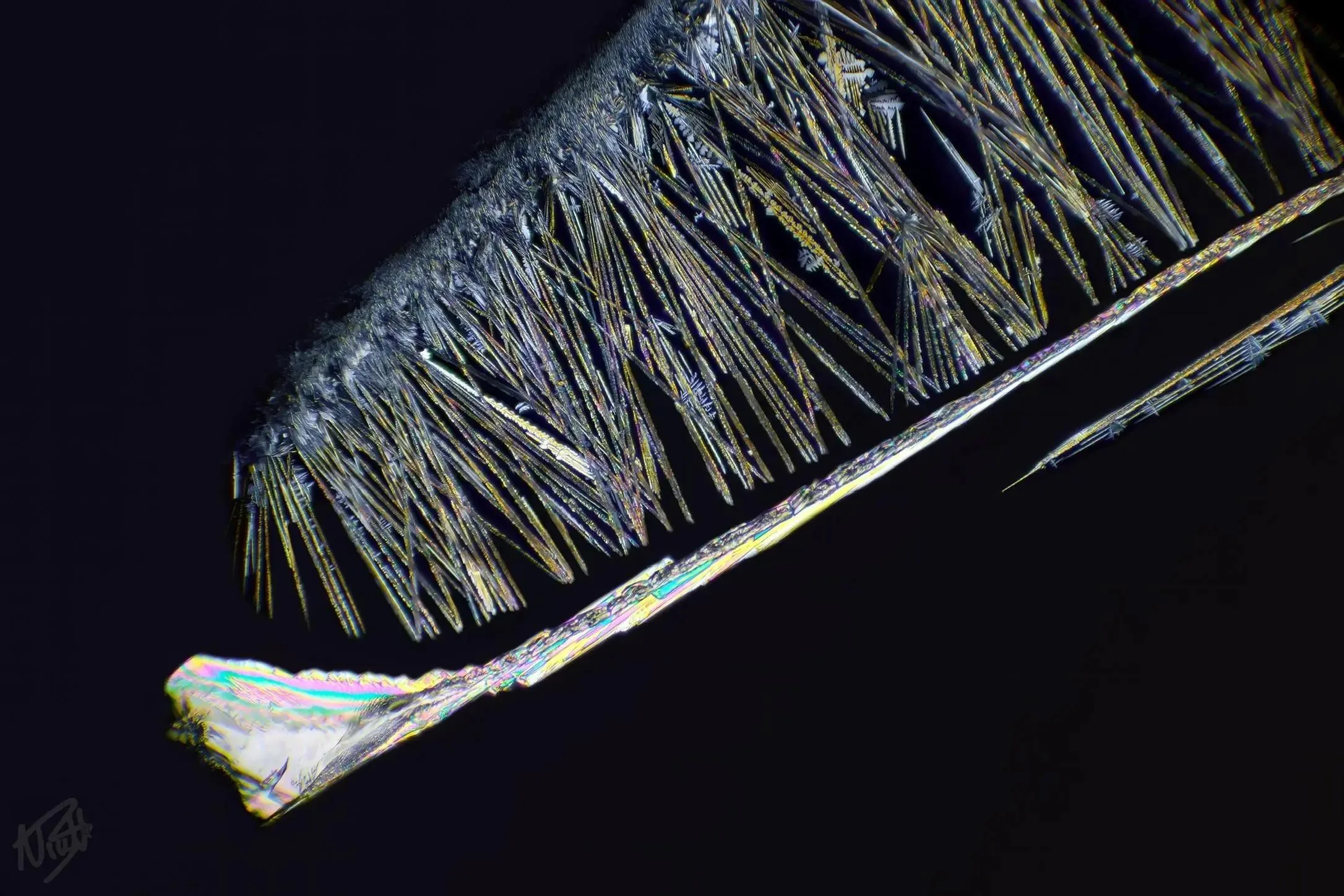
Crystal Boundary
A sharp boundary between crystalline regions reveals contrasting needle formations under polarised light microscopy. The small iridescent fragment at lower right displays vivid interference colours, characteristic of a thin crystal where phase differences in polarised light produce the full visible spectrum in a confined region.
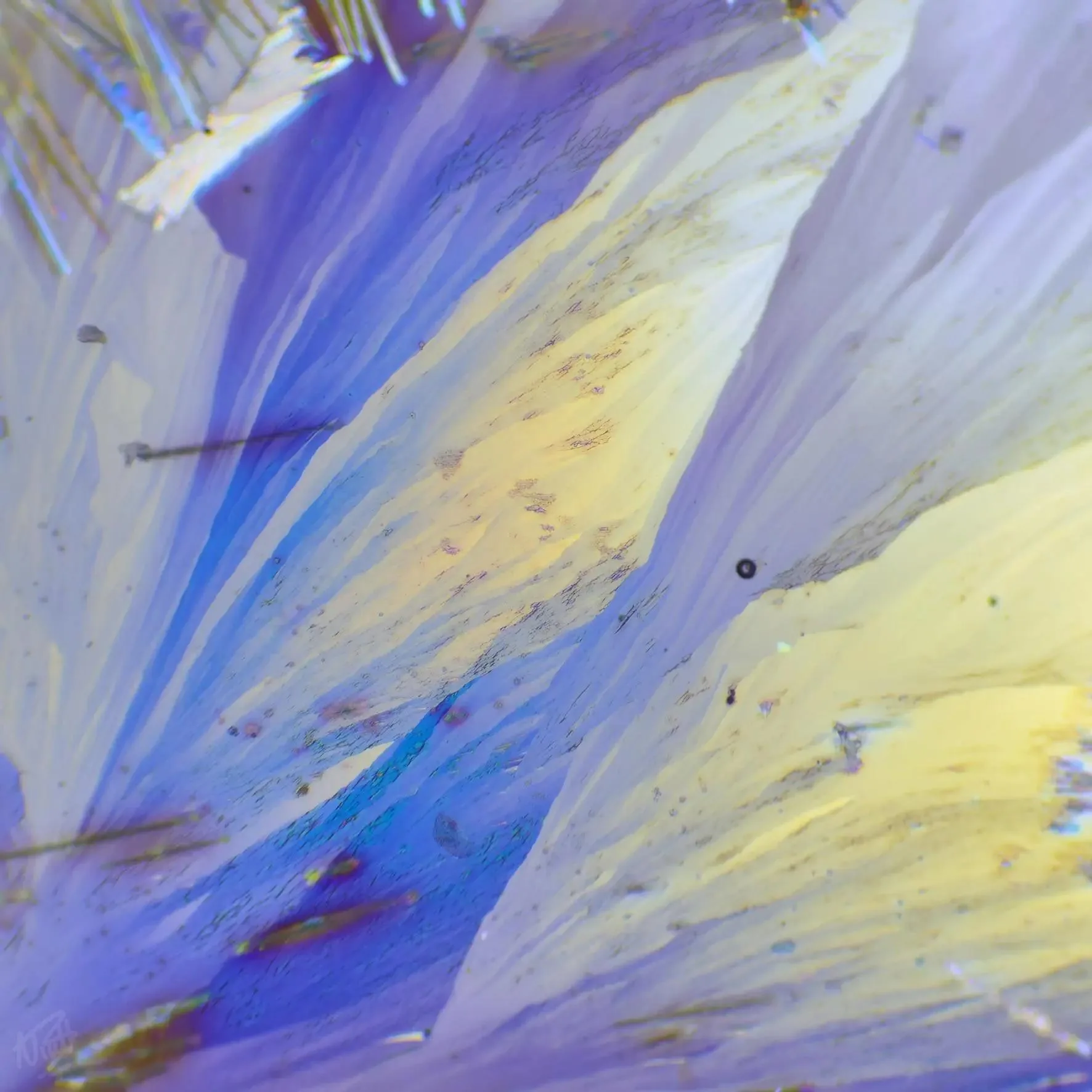
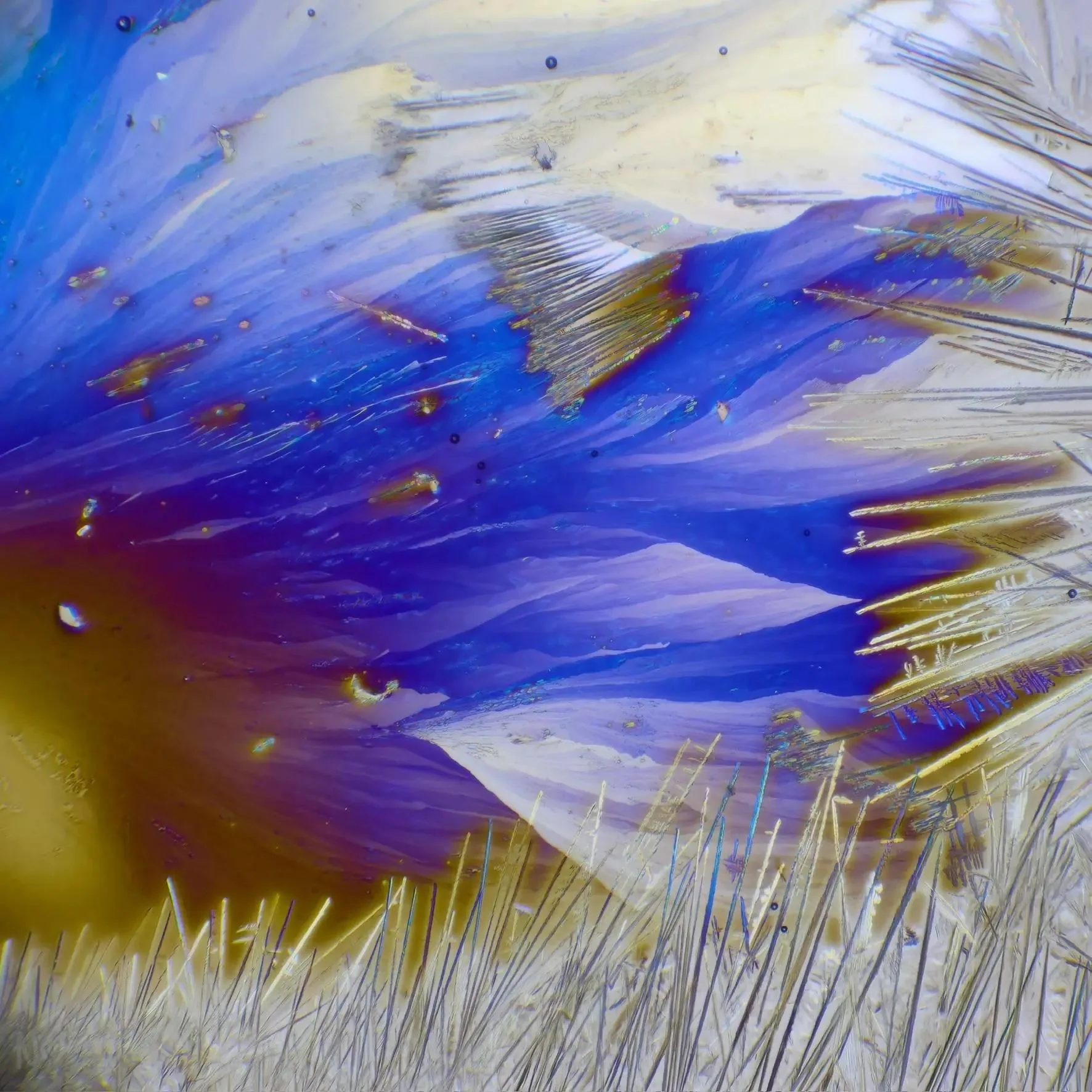
Crystal Cleavage Planes
Large, sweeping cleavage planes of a birefringent crystal glow in blue, lavender and gold under cross-polarised light. The colours arise from optical retardation, the difference in refractive index between the crystal’s two principal axes, and vary continuously with crystal thickness and orientation.
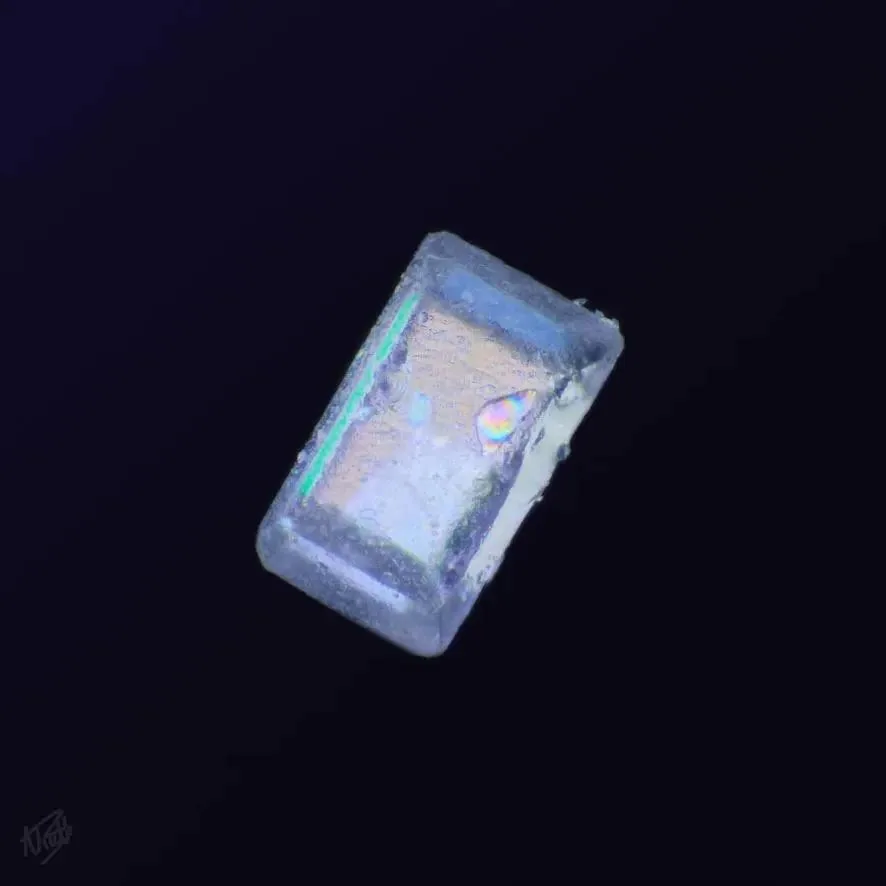
Salt Crystal
A single rectangular crystal floats against a dark background, its geometric form betraying the ordered ionic lattice within. The iridescent streak visible inside the crystal is caused by thin-film interference or internal stress birefringence, a structural imperfection that diffracts light into its component wavelengths.
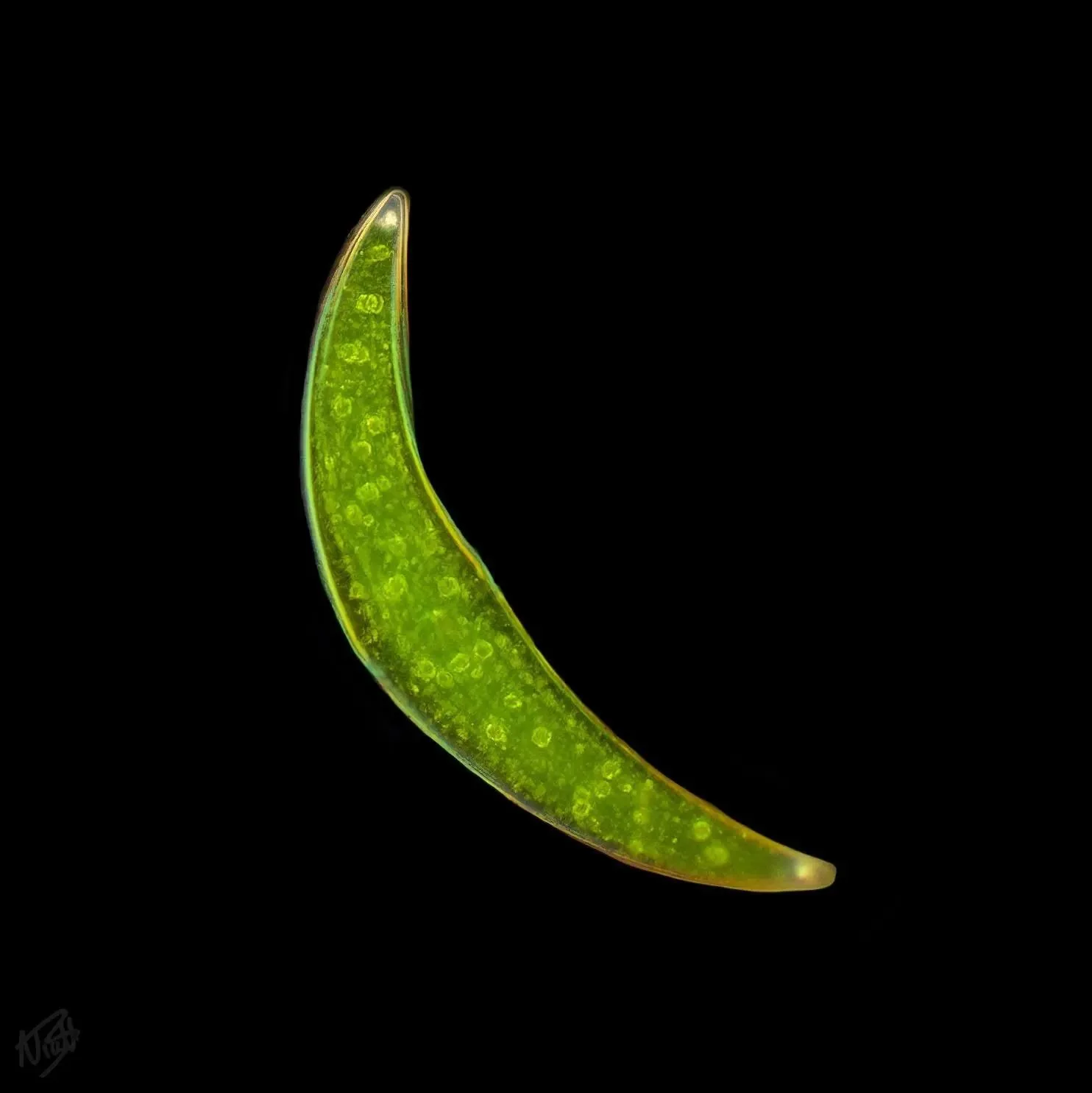
Closterium
A single Closterium, a crescent-shaped desmid alga, glows vivid green under incident light. One of the most elegant of the desmids, Closterium is a unicellular green alga found in clean freshwater habitats. Each cell contains two separate chloroplasts, one in each semicell, packed with stacked photosynthetic lamellae.
Crystal Interior
The interior of a large birefringent crystal is revealed under cross-polarised light, showing sweeping regions of blue and gold separated by sharp boundaries. These boundaries mark changes in crystal orientation or thickness and are invisible to the naked eye, becoming visible only when polarised light is used.
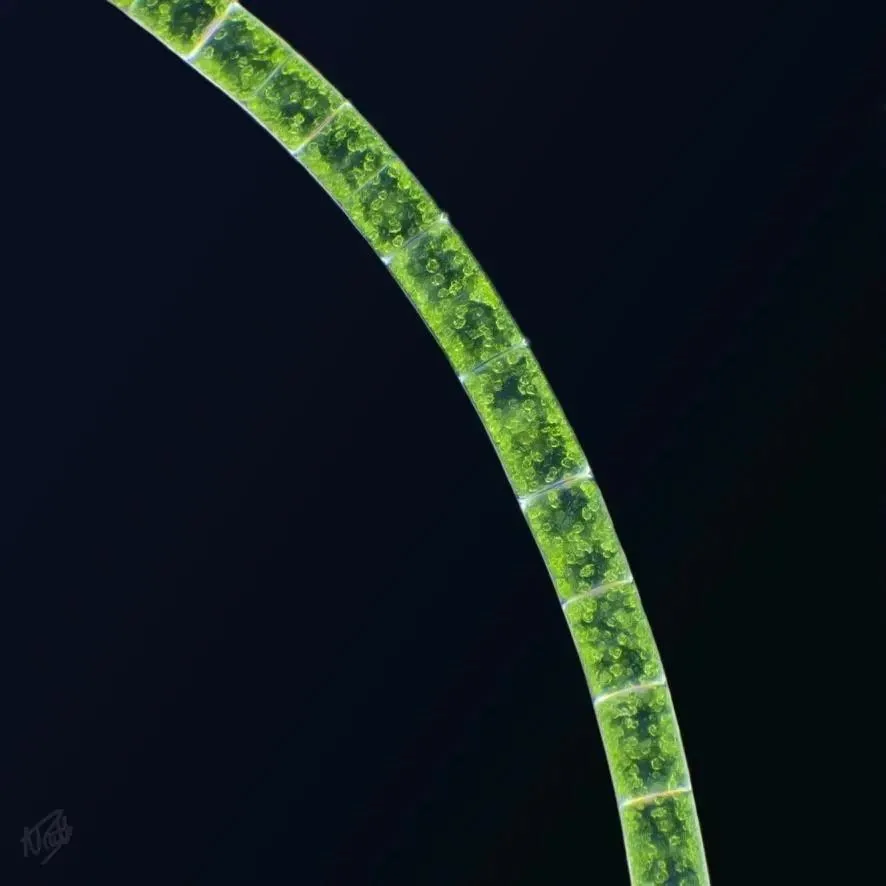
Filamentous Green Alga
A filament of a freshwater green alga, likely Spirogyra or a related genus, curves gracefully under magnification. The individual cells are clearly separated by thin walls, each packed with chloroplasts. Spirogyra is named for the characteristic spiral arrangement of its ribbon-like chloroplasts within each cylindrical cell.
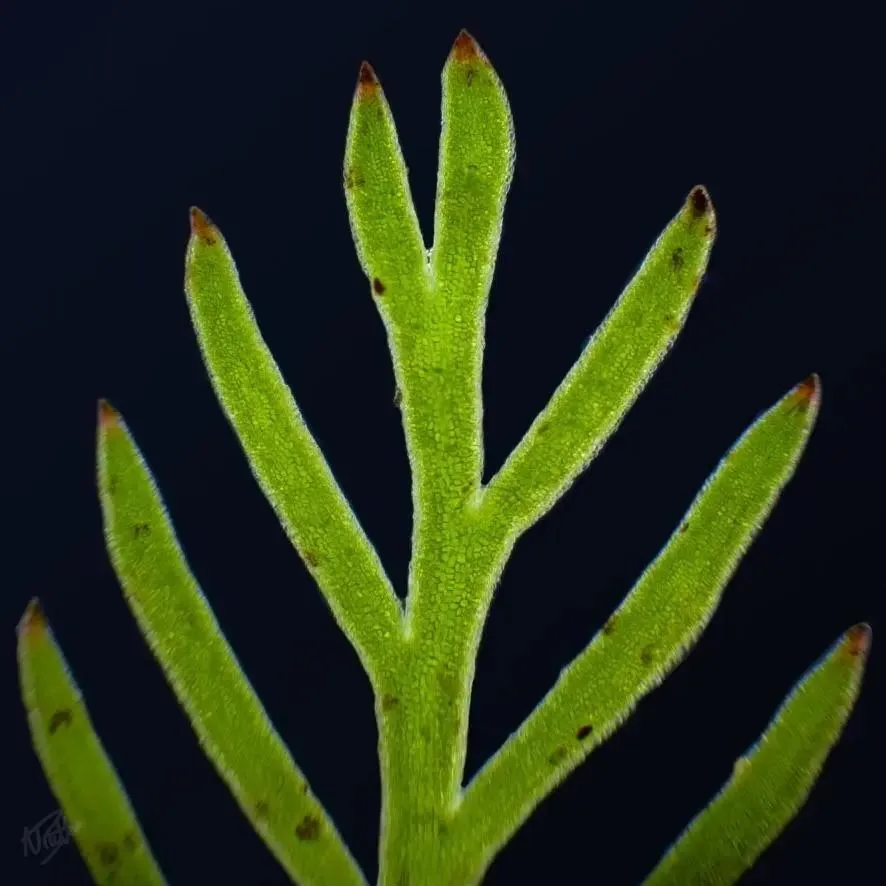
Liverwort Frond
The dichotomously branching frond of a liverwort (Marchantiophyta) reveals the intricate cell structure of its thallus under high magnification. Each tip terminates in a growing region (apical cell), and the surface is covered in fine rhizoids. Liverworts are among the earliest-diverging land plants, lacking true vascular tissue.
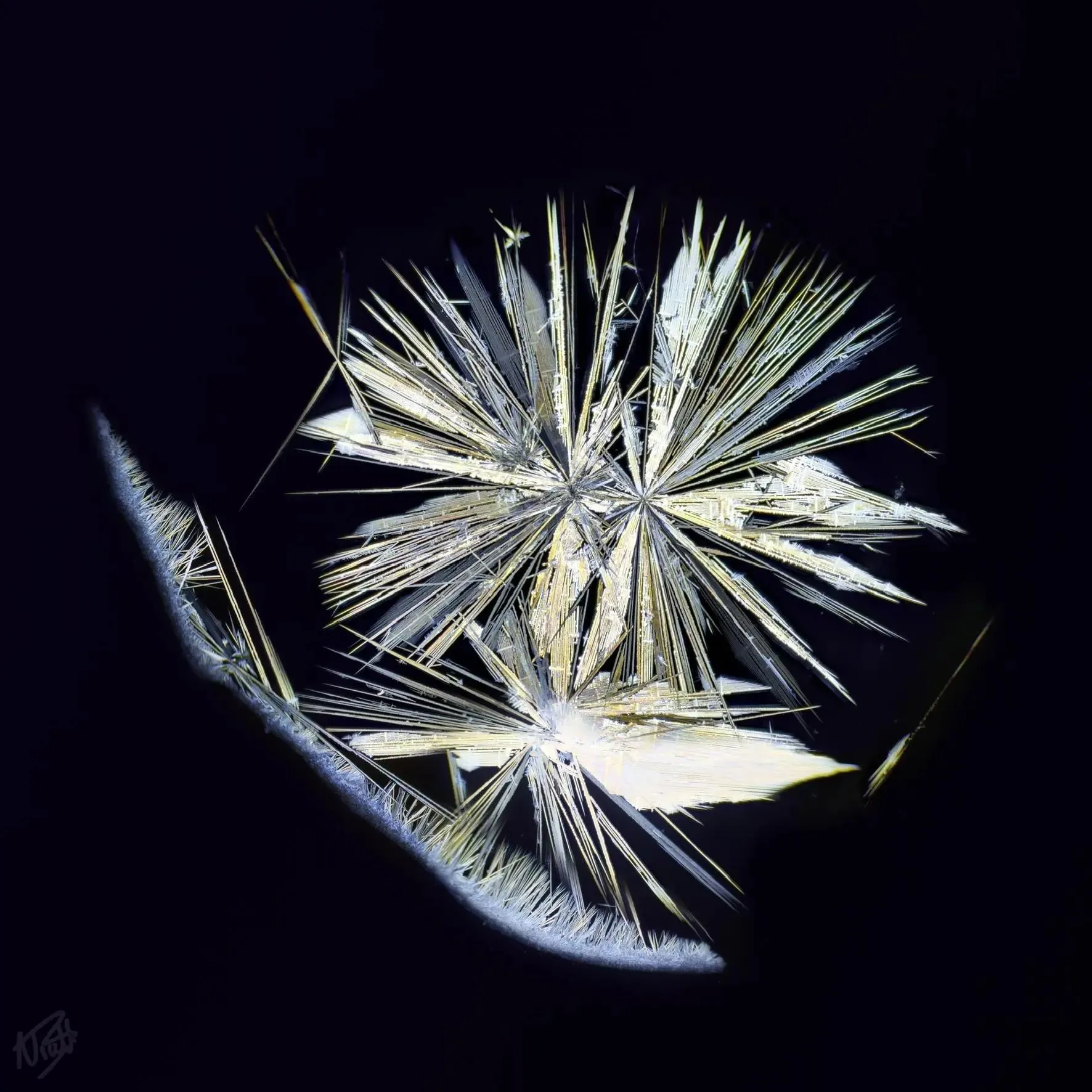
Crystal Nucleation
Needle-like crystals radiate outward from a single nucleation point, forming a starburst pattern under darkfield illumination. Rapid crystallisation from a supersaturated solution forces all growth to originate from one spot, producing this radially symmetric form. A second, smaller crystal cluster has nucleated separately to the lower left.
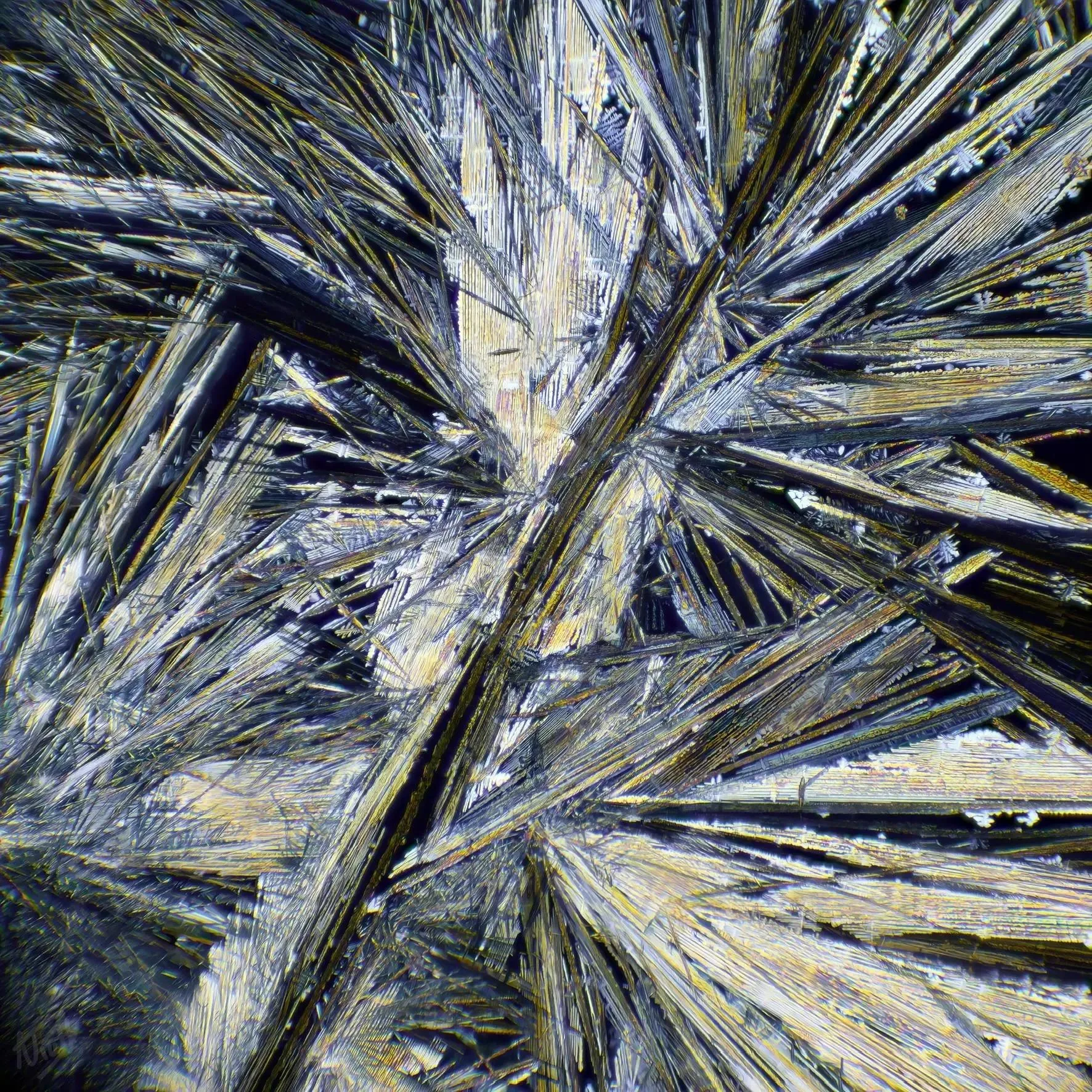
Crystal Forest
A dense array of interlocking needle crystals fills the frame, their intersecting forms creating a chaotic geometry under polarised light. The silver, gold and blue interference colours indicate multiple crystal orientations packed closely together. Needle crystal habits form when one axis of the unit cell grows far faster than the others.